Pathway Builder
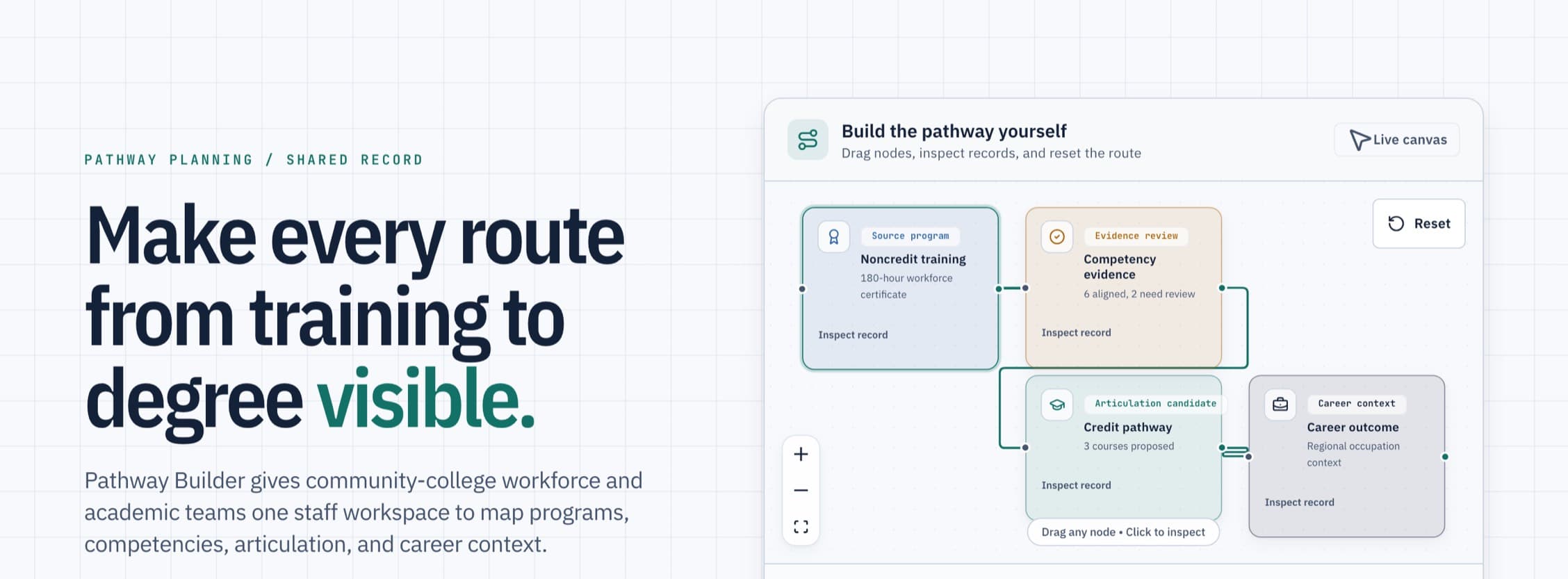
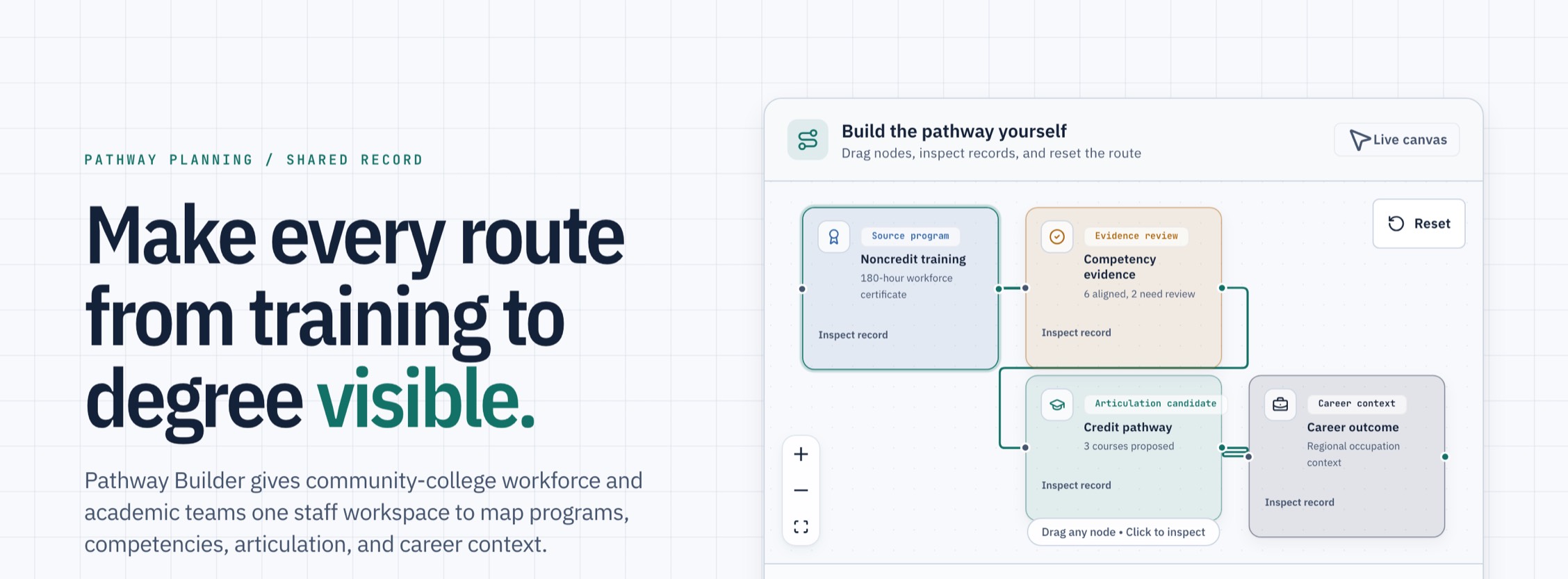
Software I built so community-college teams can map programs, courses and competencies into routes they can see, from short-term training to a degree. Right now I’m adding a place to weigh new program ideas with evidence.
- My role
- Product owner and builder
- Built with
- AI coding agents, under my own release process
- For
- Community-college workforce, continuing-education and academic staff
- Status
- Live product
The problem
Non-credit and credit teams plan in separate spreadsheets and documents. Handoffs drift, course equivalencies go undocumented, and new program ideas are often judged on a single labor-market report and a hunch.
Who it’s for
Community-college workforce, continuing-education and academic staff: program developers, deans, and curriculum and articulation teams.
What I did
I set the direction, wrote the requirements and decision rules, and built it with AI coding agents under a release process where production changes need my explicit approval.
Decisions that shaped it
Treat program ideas like investment opportunities
The opportunity workspace now being built is designed so a program idea can start as a record with only a title. Duration, tuition and capacity move from hypothesis to range to validated as evidence arrives.
Confidence never grants a go
AI output is labeled as analysis. In the design, a final go/no-go has to be made by a person and linked to at least one piece of evidence.
Make “not equivalent” a real answer
Competency mapping between non-credit and credit courses records full, partial, or reviewed-and-not-equivalent, so gaps are documented instead of silently skipped.
Useful without an account
A set of free public tools (wage lookup, career explorer, skills-gap snapshot) works without signing up.
What’s built
- Program, course and catalog import from CSV or spreadsheet, reviewed before anything is committed
- A competency library with an AI-assisted writer grounded in O*NET data, reviewed by staff
- Non-credit-to-credit competency crosswalks and gap analysis
- Regional program gap analysis using BLS, O*NET and CIP–SOC data
- A visual pathway canvas with comments, reviews and decision packets
- Articulation records with evidence and decision history
- Read-only public pathway links and printable records
- Free public tools at pathwaybuilder.app/tools
Constraints
- Each college’s data must stay separate from every other college’s, enforced in the database as well as the app.
- Federal labor-market sources (BLS, O*NET, the CIP–SOC crosswalk) have to be cited, not smoothed into false certainty.
- AI can draft; people decide. Competency drafts and go/no-go calls need human review.
- Public claims about the product must match what is actually built. There’s a written claims policy, and a test that checks it.
Part of a bigger pathHow Wavelength, Pathway Builder and Encore fit together